Of the many tools in the Safety Organized Practice (SOP) toolbox, one of the most useful — and novel — is the Three Houses tool. This visual, interactive tool helps child welfare professionals engage children and young people. Those in North Carolina and elsewhere who have used it say it can be a great way to build trust, gather information, and move a case forward.
The Tool
On one level, the Three Houses tool is straightforward. The worker asks the child to populate three houses: the House of Good Things, the House of Worries, and the House of Dreams. The idea is to use the visuals and questions to gain a deeper understanding of the child's perspective on these areas.
Younger children can draw in each house while the worker writes down what they share. Drawing is also an option for older children and adults, but most prefer to write themselves.
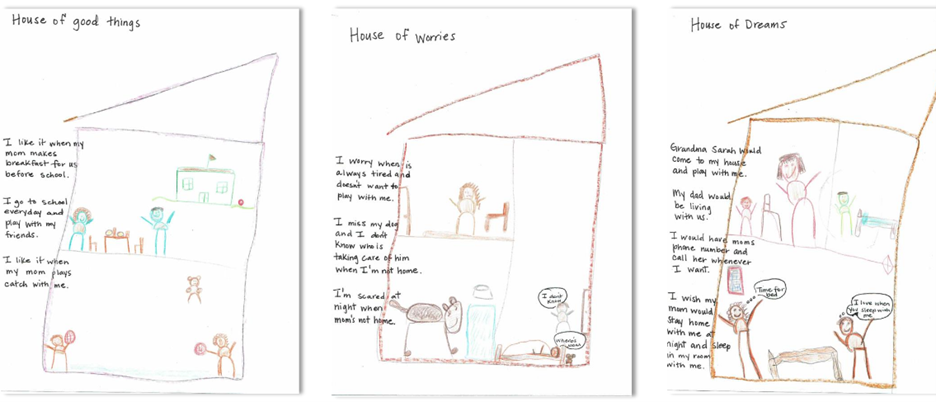
Example of the Three Houses drawn by a child. Each house invites a different type of sharing.
Who to Use It With
While the Three Houses tool is especially good at ensuring the voices of children are included in all aspects of the child protection process, it can also be used with youth and young adults. Use this tool only with children old enough to talk.
When to Use It
Do not use the Three Houses tool with all children. Use it only if you do not have the information you need and/or if traditional interview techniques are not working.
The Three Houses tool is most helpful during the investigative assessment or family assessment phase of child welfare work, but it can be useful at other times as well:
- In-Home Services: To learn the child's perspective about their safety in their home.
- Foster Care: To gain insight into how the child feels and what they need to feel safe.
- Adoption: To assess how a child feels about their pre-adoptive placement or current permanency plan.
- Case Closure: To help determine when a case should be closed.
Using Three Houses early in a case can also provide a kind of baseline: the tool can be used later to see if there are changes in the child's perspective. It can be very impactful for families to see things crossed off in the House of Worries, additions to the House of Good Things, and progress on the House of Hopes and Dreams.
10 Tips for Using the Three Houses
- Practice with a colleague or friend before using it with a child or youth.
- Have the needed materials — a template of the tool or paper on which to draw (one piece of paper per house) and crayons, colored pencils, and/or markers.
- Decide how to introduce the tool. For example: "I'd like to do something called the Three Houses with you. We draw three houses together, and in those houses you can draw, or we can write down the things you are worried about, the things that are going well or good in your life, and the things you would like to happen in the future."
- Explain how the information from the Three Houses will be used and with whom it will be shared; this models transparent communication and builds trust.
- Let the young person choose which house to start with. Feel free to move between houses in a non-linear fashion based on what is shared.
- Use follow-up prompts to find out more, such as:
- "Tell me more about this part of the drawing."
- "Explain what is happening in this picture."
- "What do you mean by what you wrote here?"
- After each house has been explored, ask if there is anything else they would like to add to any of the houses.
- As the session ends, acknowledge that what was shared was very important. If it is safe for them to keep their Three Houses, take a photo for your records before they do.
- The Three Houses can be updated or redone over time — this lets children see concrete evidence of their progress.
- Youth and young adults may prefer to fill out the Three Houses on their own and then share with you afterward. Encourage them to include more about life outside their homes, such as peers, school, work, health, and mental health.
Sharing the Results
Seeing their child's Three Houses inspires some caretakers to partner with the agency and address the child's concerns; others are less motivated. Some may even deny what their child has shared. As one trainer noted, "As frustrating as that can be, in terms of assessment, it is very useful" (NCDHHS, 2025).
Before sharing a child's Three Houses with anyone, carefully consider whether safety concerns might arise. If there are concerns, consult with your supervisor first.
To Learn More
To learn more about using the Three Houses tool, child welfare professionals in North Carolina can take the online course The Child's Voice in Assessment and Planning on NCSWlearn.org.
Three Houses Questions for Teens and Youth Transitioning Out of Care
The following questions are adapted for older youth and those transitioning out of foster care.
| Worries | Good Things | Hopes and Dreams |
|---|---|---|
| For Teens | ||
|
|
|
| For Youth Transitioning Out of Care | ||
|
|
|