
Delays in children's permanency can have lasting impacts on early brain development, attachment, and long-term well-being. Achieving timely permanence requires intentional collaboration between child welfare agencies and the courts. Recognizing this shared responsibility, North Carolina's Safe Babies Court (SBC) initiative offers a collaborative court process designed to support families early, reduce barriers, and move cases forward with transparency and purpose.
Safe Babies Court is best understood as a process, not a program — one that brings courts, child welfare, attorneys, Guardians ad Litem, parents, and community partners together around the common goal of timely and developmentally informed permanence. In April 2025, Practice Notes introduced SBC in the article The Safe Babies Court Program: A Model for Collaborative, Family-Centered Child Welfare. This article is an update on this successful collaborative effort.
Collaborative Alignment
According to SBC's State Director, Polly Handrahan, and State Coordinator Jadie Baldwin-Hamm, Safe Babies Court was designed to align with established child welfare and court processes. The model recognizes that timely permanence cannot be achieved by one system alone, and that achieving permanence requires strong partnerships, shared data, and a willingness to step out of silos.
Implementation of SBC typically takes four to six months and incorporates principles from Zero to Three, ACEs-informed (adverse childhood experiences) practice, and trauma-informed care. SBC's preparation phase helps ensure that court professionals, child welfare staff, and community partners share a common understanding of child development, trauma, and how these factors influence both family engagement and court decision-making.
While SBC is still new — having started in NC in 2023 — Handrahan notes that partners are increasingly seeing how the process benefits everyone involved, especially families. The shift toward a less adversarial, more problem-solving court environment has helped build trust and improve communication across systems.
Core Components
Safe Babies Court includes three core components that directly support timely permanence by improving coordination, transparency, and shared accountability.
1. Active Community Teams
One of the most impactful components of Safe Babies Court is the Active Community Team. A multidisciplinary group of judges, DSS staff, attorneys, GALs, community coordinators, mental health providers, early intervention specialists, and parent partners, the team works to identify available services, uncover gaps, and improve coordination among providers. Community coordinators gather and share information about local resources not only for SBC cases, but for all cases — including criminal court and juvenile court cases — helping to support the broader system.
In western North Carolina, for example, Active Community Teams collaborated with transportation providers across five counties to better understand scheduling challenges. Providers explained the logistical realities of operating in mountainous areas, such as the need to return vehicles before dark. This dialogue led to more realistic scheduling and improved communication, helping to reduce unnecessary barriers for families.
Active Community Teams in the region are also increasing the capacity of mental health providers to engage families. Providers noted that the involvement of families living in the mountains sometimes fell off after the initial contact. To address this issue, Active Community Teams are offering training about engaging Appalachian families to providers, caseworkers, and community partners.
2. Site Implementation Teams
Each Safe Babies Court site has a team that oversees implementation and later evolves into a leadership team. These Site Implementation Teams typically include parent attorneys, Guardians ad Litem, DSS staff, and other court partners.
The team reviews data together, discusses court processes, and asks critical questions such as: Are time standards being met? Where are cases getting stuck? What does the data tell us about our progress toward timely permanence? This shared review supports continuous quality improvement and helps break down silos between systems.
In Brunswick County, the Site Implementation Team takes collaboration a step further by visiting different service providers. This allows court and child welfare partners to better understand available services, potential barriers, and service quality. As a result, conversations with parents in court are more informed and meaningful, and recommendations are grounded in firsthand knowledge.
3. Judicial Status Conferences
One feature unique to NC's Safe Babies Court is how judicial status conferences are held. These conferences move discussions out of the formal courtroom — judges come off the bench and sit alongside parents. The conversation is parent-led, focusing on progress and needs.
While the frequency of conferences may initially feel like additional work, Baldwin-Hamm emphasized that they often reduce work later. Because these conferences are not formal hearings, no additional court reports are required. This reinforces a less adversarial approach. Conferences have led to reduced time spent waiting in court, benefiting both families and child welfare caseworkers.
Implications for Child Welfare Practice
Safe Babies Court has important implications for child welfare practice. Rather than adding tasks, it supports caseworkers by strengthening partnerships and lightening the load. Local SBC coordinators work alongside child welfare staff, helping make connections to resources, communicating with collaterals, and engaging stakeholders. This shared responsibility helps everyone work together more efficiently instead of working in silos.
Transparency plays a key role. Family Team Meeting notes are shared with all partners, ensuring everyone understands the plan, progress, and barriers. As a result, SBC cases move more quickly since everyone is informed of progress along the way.
Handrahan noted the overarching goal of SBC is to support child development by reaching permanence as early as possible. While reunification remains a priority, timely permanence also includes guardianship or adoption when reunification is not possible. Even in those circumstances, the SBC process emphasizes supporting parents, strengthening shared parenting, and creating a positive support plan that can promote healing and better outcomes for children or sibling groups.
Current Status and Looking Ahead
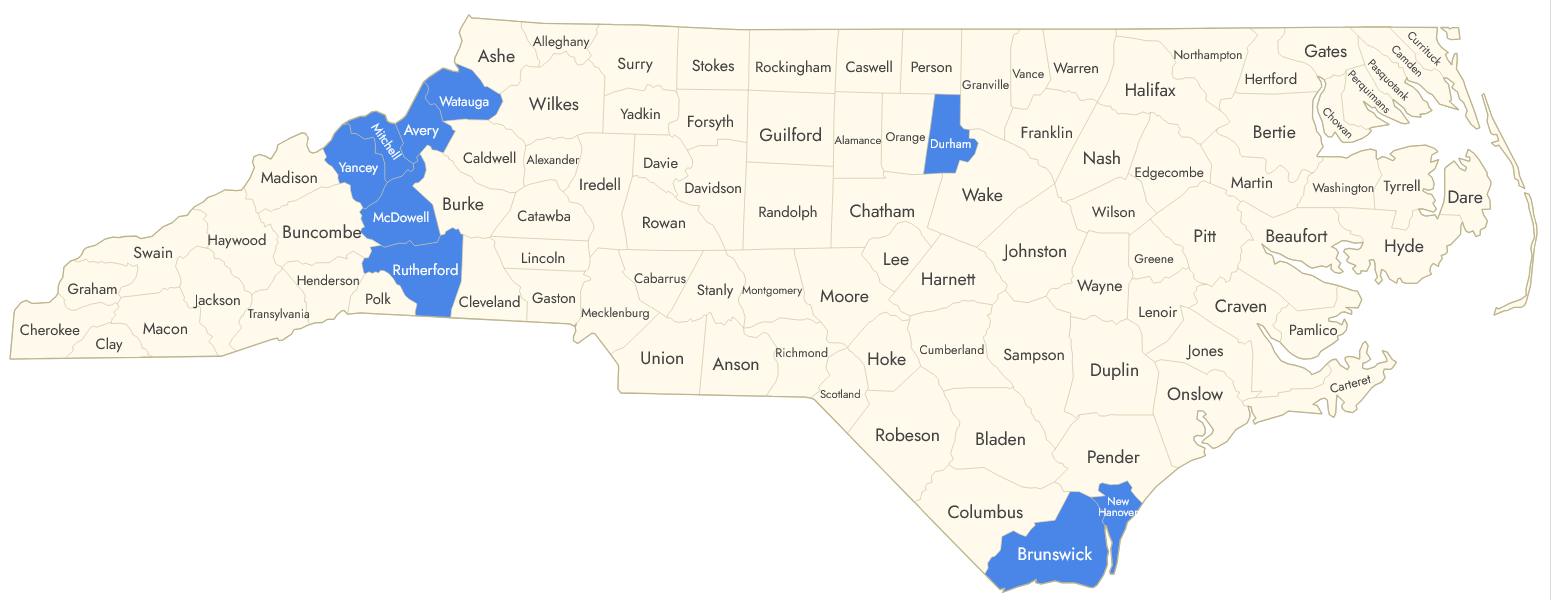
Participating SBC Counties, March 2026
Safe Babies Court is currently operating in Avery, Brunswick, Durham, McDowell, Mitchell, New Hanover, Rutherford, Watauga, and Yancey counties. Funding is secured until June 2027 through the Dogwood Health Trust and The Duke Endowment, with ongoing efforts to build long-term sustainability.
At present, approximately 100 families with 130 children are enrolled statewide. Fourteen cases have already reached permanence, including ten reunifications, three guardianships, and one adoption — all placements with family members.
As the initiative moves forward, child welfare system data and geographic considerations will be used to guide thoughtful expansion. The long-term vision is statewide availability that leverages local resources while maintaining fidelity to the Safe Babies Court model.
For more information on Safe Babies Court, watch a short video or contact Polly Handrahan or Jadie Baldwin-Hamm.