North Carolina has adopted a practice model to help our child welfare system shift from doing to families to working with them. This model is supported by three components, just like a three-legged stool. One leg is the child welfare practice standards. Another is policy, which includes the use of the revised Structured Decision Making tools. This article focuses on the third leg: Safety Organized Practice — tools and strategies that strengthen partnerships with families and communities while keeping child safety at the center.
Practice Model Components
North Carolina's practice standards describe how leaders, supervisors, and workers should interact with children, youth, families, and other child welfare staff. Each standard has key behaviors and core activities that staff at all levels should practice:
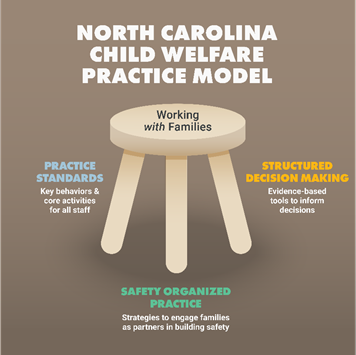
NC's Child Welfare Practice Model rests on three components: practice standards, Structured Decision Making tools, and Safety Organized Practice.
- Communicating — how to listen, share information, maintain transparency, and build trust
- Engaging — involving children, families, and relevant stakeholders; building rapport and partnerships; investing in staff well-being and development
- Assessing — evaluating safety, risk, needs, and strengths; ongoing monitoring to assess performance
- Planning — creating a case/family plan that includes safety goals, permanency, and well-being; mapping out interventions and responsibilities, inclusive of families, staff, and partners
- Implementing — putting the plan into action; monitoring progress; making adjustments; ensuring services are delivered; celebrating success
Click here to read more about tools supporting the implementation of practice standards.
Structured Decision Making (SDM) tools are evidence-based assessments and protocols that guide and inform child welfare decisions, promoting consistency, objectivity, and alignment with best practices. Counties are actively implementing revised SDM tools including Screening and Response, Safety Assessment, Family Risk Assessment, and the Family Strengths and Needs Assessment.
Safety Organized Practice (SOP) supports the implementation of both the practice standards and SDM tools by providing a consistent framework that engages families as partners in building safety. SOP has three major objectives: (1) developing good working relationships, (2) using SDM tools and critical thinking, and (3) building collaborative plans that enhance daily child safety.
SOP Tools
The following SOP tools blend structure with collaboration to improve child welfare outcomes of safety, permanency, and well-being.
Three-Column Mapping
Three-column mapping is a cornerstone of SOP. This tool organizes conversations into three essential questions:
- What are we worried about? (harm and worry)
- What's working well? (strengths and protective capacities)
- What needs to happen? (safety plans and next steps)
This structure balances concerns with strengths, ensuring families are recognized not only for their challenges but also for their resilience and capacity for change. For more on three-column mapping, see Enhancing Child Welfare Visits Through Safety Organized Practice Tools.
Harm and Worry Statements
Provisional harm and worry statements are developed during Screening and Response to help families, children, and networks understand concerns in concrete terms. They are "provisional" because the information reported has not yet been confirmed through a CPS assessment. Harm statements summarize a reported impact that has already occurred on a child; worry statements focus on what the agency fears will happen if nothing changes. For example:
- Harm: The reporter stated that Ms. Smith left her child, Betty (7), home alone overnight. Betty stated to the reporter that she was scared to be alone.
- Worry: Betty could be hurt by an accident and feel scared without an adult to care for her if she is left alone overnight.
To learn more, take the e-learnings Provisional Harm and Worry Statements at Intake and Harm, Worry, and Goal Statements on NCSWlearn.org.
Safety Plans
Safety plans are written as observable, measurable actions adults will take to ensure children's ongoing safety. Action steps go beyond intentions — they are commitments that can be demonstrated and monitored over time. For example, rather than a vague commitment:
A more concrete, actionable commitment:
SOP calls for families to help write and agree to safety plan goals. Workers can also use scaling questions to assess a parent's willingness, capacity, and confidence with the plan. For example:
- Willingness: "On a scale from 0 to 10, where 0 means you are unwilling to have your neighbor stay overnight with Betty and 10 means you are totally willing, where are you?"
- Capacity: "On a scale from 0 to 10, where 0 means you can't transport Betty to childcare and 10 means you have no barriers, where are you?"
- Confidence: "On a scale from 0 to 10, where 0 means you are not at all confident this plan will work and 10 means you are totally confident, where are you?"
Safety plans are not static — they are living documents that evolve as circumstances change and progress is made.
Building Safety Networks
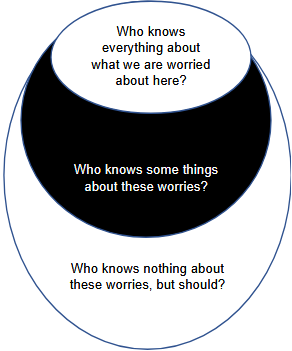
Circles of Safety and Support
A strong safety plan cannot rely on child welfare alone. SOP prioritizes creating a safety network — extended family, friends, and community members who support the family and help monitor safety. These networks make safety plans sustainable long after child welfare involvement ends.
If a family has difficulty identifying people in their network, use a visual tool such as a Circles of Safety and Support diagram and ask prompting questions:
- Inner circle: Who are the first people you call when you are in need?
- Middle circle: Who supports you a little?
- Outer circle: Who have you not reached out to? What would it take to move them to your inner circle of support?
To learn more, see Using Circles of Safety and Support to Create Safety Networks with Families.
Solution-Focused Practice
SOP encourages solution-focused practice to increase opportunities for solutions — it invites people to think about the ways they resolve problems rather than dwelling on them. When child welfare staff use solution-focused questions with families, they empower the family, not the problem. These questions uncover times when problems were managed differently (exceptions) and concentrate on strengths and solutions that the family identifies. For more, see Solution-Focused Questions in Child Welfare Practice.
Tools Engaging Children
Children's voices matter. SOP includes age-appropriate tools to ensure children understand what is happening and can contribute to the planning process:
- Three Houses. This tool helps workers engage with a child or youth during a CPS assessment and safety planning. There is a House of Worries, a House of Good Things, and a House of Hopes and Dreams. Children can draw, write, or describe what belongs in each house. For more, see Using the Three Houses Tool.
- Safety House. This tool is used throughout the child welfare service continuum. A child draws themselves in the center of a house, fills in things they enjoy or like about their family, identifies a support circle around the house, marks unsafe people in a separate circle, and adds rules to the roof — creating a personalized safety map centered on the child's own experience.
Conclusion
Safety Organized Practice is more than a set of tools — it is a mindset. It creates shared understanding, builds networks of support, and emphasizes clear, behavior-based plans that can be sustained over time. By blending structure with engagement, SOP strengthens partnerships with families and communities while keeping child safety at the center.