In child welfare work, we need partners outside our agencies to achieve the outcomes we seek. This is especially true when it comes to timely permanence for children and youth. Even the most skilled and well-supported social worker cannot control the pace or timelines of a child's legal case.
At the agency level, access to and understanding of performance data—our court partners' as well as our own—is necessary if we are to understand and increase the effectiveness of our efforts. Shared data and clear communication enable both systems to understand roadblocks to timely permanence and allow managers and court personnel to work creatively to overcome those challenges.
To support collaboration between our state's child welfare agencies and its courts, Practice Notes would like to spotlight the following North Carolina data sources.
Permanency Performance Profiles
Created to support District Permanency Collaboratives (see sidebar), the Permanency Performance Profile provides administrative data from the court system (JWISE), child welfare administrative data, and case review data from the Onsite Review Instrument (OSRI). The profile comes in the form of a downloadable Excel file; a new profile is available for download every quarter.
The Permanency Performance Profile provides a wealth of data points, including:
- Court Improvement Program measures (e.g., time to first permanency hearing)
- Hearing time standard reports (e.g., number of adjudication hearings held more than 60 days after the filing of the petition)
- CFSR measures (e.g., permanency in 12 months for children in foster care 12–23 months)
- OSRI measures (e.g., cases where permanency goal for child was rated as a strength)
Instructions are included on the first tab of the Excel file. In general, use the green drop-down cells to select county, historical timepoint, and measure. Note that after downloading the file, some data points will be missing—counties/districts must retrieve hearing time standards data from JWISE and manually add them to the file.
To assist users, NCDHHS has created a Usage Guide with more detailed instructions and descriptions of the measures included in the profile.
To access the NCDHHS Permanency Performance Profile and other supporting information, click here.
Creating Indicators for Child Welfare
A successor to the website Management Assistance for Child Welfare, Work First, and Food & Nutrition Services, Creating Indicators is a site that provides data and charts that can help North Carolina child welfare professionals, as well as the general public, in several ways, including:
- Understanding what happens to children and families who become involved in the child welfare system.
- Providing easy access to detailed information about the experiences of children who enter the custody of a NC county department of social services (i.e., "placement authority").
- Making it possible to track experiences from the initial placement through all subsequent placements, up to and including permanent placement with the child's birth family, an adoptive family, or a guardian.
By compiling information about all the children who enter placement authority, it is possible to understand the changing dynamics of participation in child welfare programs, particularly out-of-home care. In addition to producing reports for individual counties, the website can provide reports for all the children entering care statewide. This includes reports for groups of counties of a similar population size and for judicial districts.
To use the site, use the "County Selector" button at the top left to select a specific county, region, judicial district, or the entire state. After that, use the menu under the title bar to select the desired category—options there are Abuse & Neglect, CFSR, Experiences Report, and Children in Foster Care. The figure below illustrates just one of the many data points available through this site.
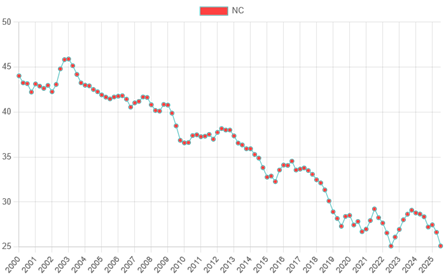
Permanency in 12 months for children entering foster care (all years)
Buttons at the top right on each page include a blue "i" icon that reveals general help files. If you have comments or questions, click the envelope icon, which takes you to a form for contacting site staff.
To access the Creating Indicators for Child Welfare website, click here.
PATH NC
Last but certainly not least, there is North Carolina's new case management system, Partnership and Technology Hub for North Carolina (PATH NC). Launched by NCDHHS in June 2025, this electronic child welfare records platform replaces manual, paper-based processes with real-time digital tools for tracking foster care, case management, and child safety, enabling better data sharing across the state. By November 30, 2026, all 100 counties will be using PATH NC for CPS Intake, Assessments, and Ongoing (In-Home and Permanency Planning) services, creating a comprehensive source of accurate, real-time data for agencies. In the future, PATH NC will be a key data source for North Carolina child welfare agencies engaged in permanency-focused partnerships with the courts.