
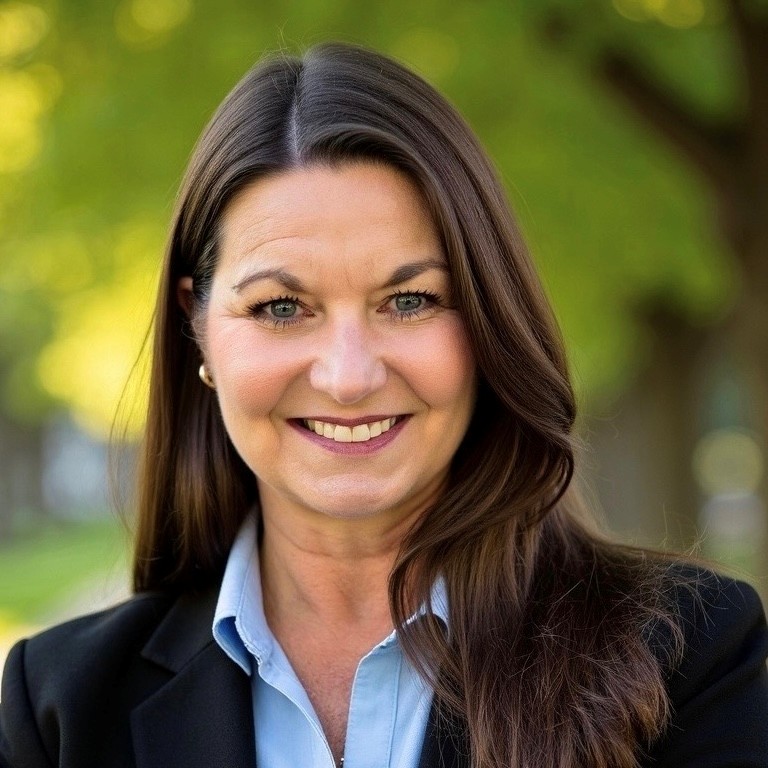
Chief Judge Beth Dixon
Across North Carolina, we often hear about barriers to successful partnerships between courts and child welfare agencies. Lack of understanding of roles, scheduling delays and continuances, adversarial relationships, and high turnover of attorneys have all been cited as challenges that can make it difficult to achieve timely permanency for children and youth. Yet there are partnerships out there that are working well — including the one in Rowan County.
To learn about this successful partnership, Practice Notes spoke with District 19c's Chief Judge Beth Dixon, Director Micah Ennis, and Program Administrator Roxie Cashwell from the Rowan County Department of Social Services (DSS).
Judicial Leadership Sets the Tone
According to Cashwell and Ennis, consistent judicial leadership is the foundation. Under Judge Dixon, child welfare court improvement has been a sustained priority. Judge Dixon partnered with the National Council of Juvenile and Family Court Judges (NCJFCJ) to provide training and facilitation focused on improving partnership and outcomes. The principles that guided this work are in the sidebar.
With NCJFCJ's help, Rowan County created a change team that involved all stakeholders, including parent attorneys, DSS staff and attorneys, GAL, and judges. Together, this team worked to understand the issues specific to Rowan County and learn new ideas from each other's perspectives. "I'm a huge advocate of multidisciplinary training," Judge Dixon emphasized. "We should all be hearing those same messages at the same time." Inviting stakeholders like these to a training provides an opportunity to develop connections.
To build a successful collaborative team, Ennis stressed the importance of framing child safety and permanency as shared community responsibilities, not challenges to be handed off or blamed on another system. Rather than saying, "The system is broken—you fix you," Rowan County took the stance, "We need to fix us, and we can't do it alone."
Collaboration requires trust and intentional relationship building. Ennis emphasized, "Entities don't have relationships. People do." Individuals within DSS built trust with individual judges, clerks, GALs, school partners, and nonprofit providers—often by showing up when needed, offering help, and developing a network of reciprocal, community minded relationships. These relationships allowed for more open conversations and a different approach to sharing consistent feedback and clarifying mutual expectations. According to Ennis, these partnerships endure not because they are mandated, but because leaders prioritize them.
Transparency Builds Trust
A turning point in Rowan County was the decision to openly share data with court partners. Transparency signaled accountability and invited collaboration. Even though the data was not perfect, Ennis felt it was an important first step to demonstrate open communication and trust. "We had to be willing to share all of it—good, bad, and ugly—and encourage inquiry."
Rowan DSS regularly shared data with court partners on permanency timelines, placement stability trends, time to adoption or reunification, and 60-day adjudication compliance. Ennis admitted that sharing data requires cultural change. Staff initially feared external scrutiny, but Ennis believes leadership must model openness and be willing to take that risk.
Judge Dixon monitors these metrics closely and communicates with partners if concerns arise. "If we start seeing something that's not right, she's getting in contact with our attorney," Cashwell said. Judge Dixon will ask, "'Hey, what's going on with this? We need to make sure we're where we're supposed to be.'"
Today, reviewing data is a routine component of partnership meetings. Everyone monitors metrics closely, and quarterly permanency collaboratives reinforce shared ownership of outcomes. (For more on data sharing, see the article Data Sources to Support Permanency-Focused Partnerships in this issue.)
Improved Practices
Many changes have been implemented because of these efforts, including strategies to reduce continuances. Judge Dixon believes addressing continuances requires being intentional and working together to develop a continuance policy.
In Rowan, consistent expectations helped shift courtroom culture. "Once this continuance policy was in place and applied consistently over time attorneys had to adapt," Dixon explained. Now, she says, "attorneys don't come [to court] expecting a continuance. Continuances need to be seen as not an option, and everyone needs to be committed to this goal. Continuances should be rare and only for situations that we cannot control."
Other procedural changes also helped reduce continuances. For example, the next court date is usually scheduled while everyone is in the courtroom. This practice ensures families, attorneys, and DSS staff know the next hearing date months in advance. This reduces scheduling conflicts.
In addition, DSS requires court reports to be submitted weeks before hearings. Cashwell explained, "Supervisors have court reports due three weeks in advance. Then it goes to our attorneys to review before we submit it to the court." As a result, attorneys and judges receive well-prepared reports, and the likelihood of delays during hearings is reduced. Rowan County also ensures that DSS attorneys are prepared. DSS attorneys attend weekly high-risk case meetings; this ensures they understand cases early, which reduces friction later.
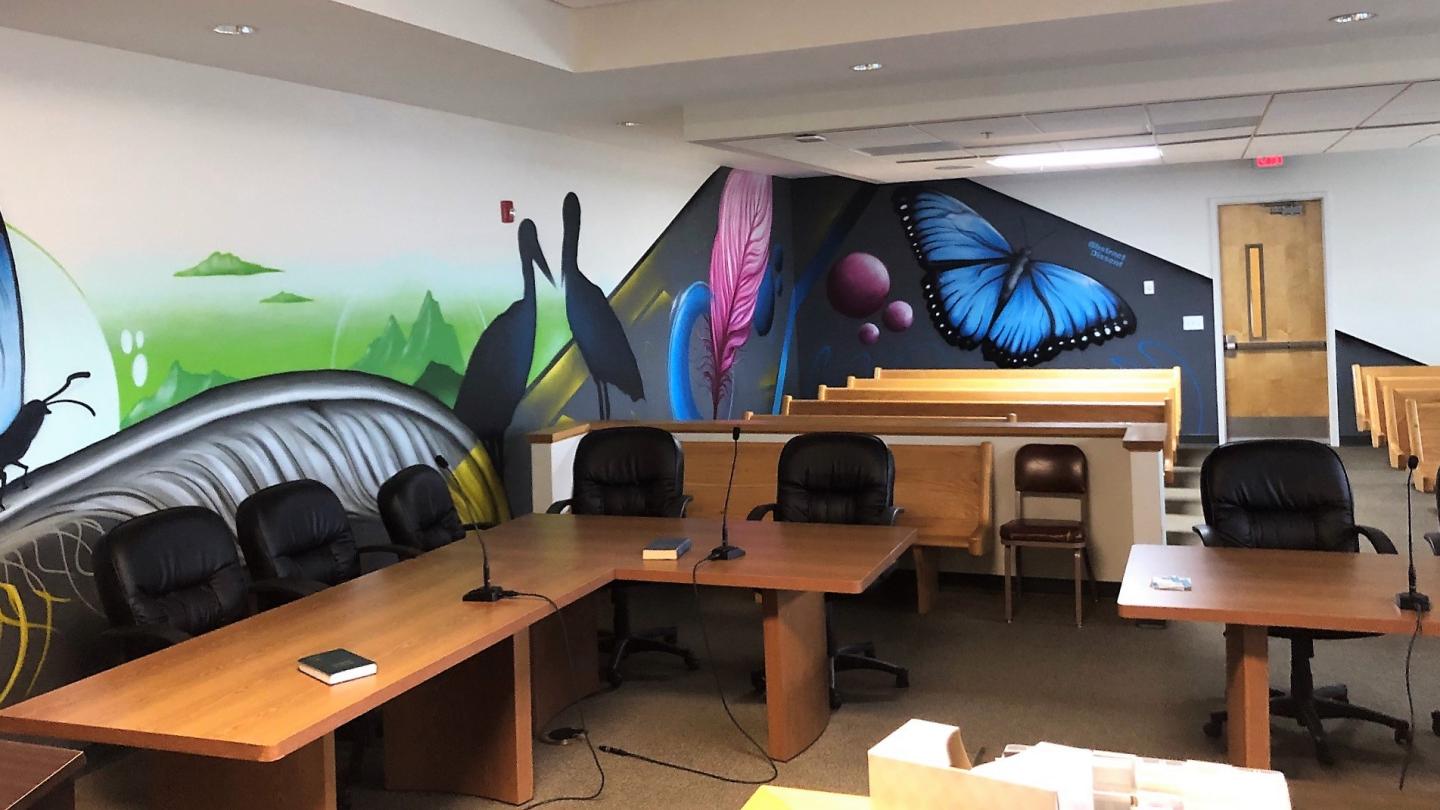
Courtroom number five in Rowan County.
(Photo Credit: NC Judicial Branch, 2023)
Judge Dixon also reduced the number of judges rotating through court. She explained, "We used to have all five of our district judges rotate through... and we have narrowed that down to two judges that are trained in this type of work." She believes this change allows judges to closely monitor cases and reduces the time they need to catch up prior to each court date.
The team has also made the courtroom more family friendly. Through a small grant, Judge Dixon was able to have the courtroom painted with a mural that changed the tone of the space. While seemingly a small change, Judge Dixon said, "I know it makes me happier to work in that courtroom, and we hope it makes it easier for families and children to be there."
Outcomes
These collaborative reforms have produced measurable improvements in permanency outcomes. As the figure below shows, Rowan County's average time to adjudication decreased dramatically—from 128 days in 2020 to 53 days in 2024. Most cases now meet the statutory 60-day adjudication requirement. "We can feel like court is different—but the data shows it," Cashwell said.
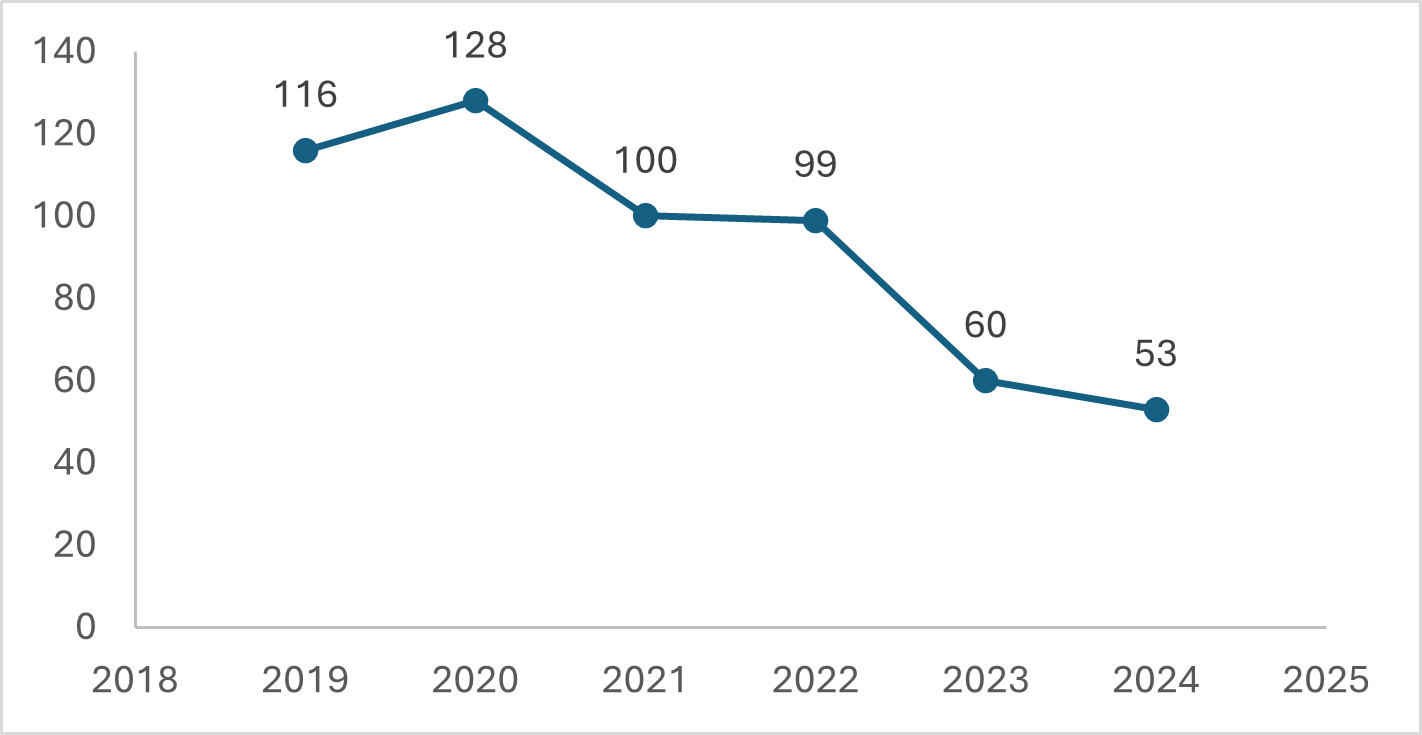
Average Days to Adjudication in Rowan County
Data analysis also helped the county identify the need for additional court capacity. After reviewing caseload trends, they added extra court sessions to manage the volume of cases requiring adjudication. "That came because the data showed we had all these cases that needed to be adjudicated and we didn't have time to do it," Cashwell explained.
Start with What You Control
When asked what other counties should do first, common themes were clear:
- Look at your data. What does it say about your system? What is within your influence to change?
- Start conversations about the system, not individual cases. Use existing meetings, such as permanency collaboratives, to introduce data discussions.
- Identify shared goals. No one wants children to linger in foster care unnecessarily.
- Take small, actionable steps. Momentum builds through consistent follow-through.
Ennis encouraged leaders to focus on their circle of influence and control: "What part of this belongs to me? What can I control?"
Judge Dixon stressed that counties should not assume judges do not want to work with them. Reach out and ask for a meeting. "Not all judges understand what the permanency outcomes mean from the DSS perspective," she explained. "We know the law, but we don't know social work."
Judge Dixon encourages DSS to invite judges to the table and show them what the numbers mean. "Everyone wants better outcomes for children and families, and we just need to understand how we work together to accomplish that."
"Everyone wants better outcomes for children and families, and we just need to understand how we work together to accomplish that."
— Chief Judge Beth Dixon, District 19c"Our permanency outcomes are strong because of decades of investment in the conversation," Ennis explained. Cashwell agreed, saying, "The improvements did not come from a single initiative. They came from staying at the table."
Strong court partnerships are built—not assumed. They require transparency, humility, structure, and sustained leadership. When those elements come together, children move more quickly and safely toward permanency.